

Enjoy this article by Sung J. Woo. It may focus on the Commodore 64, but I think it applies to most of us that were around in the 80s. — Paul
(If you prefer, you can also listen to the audio version.)
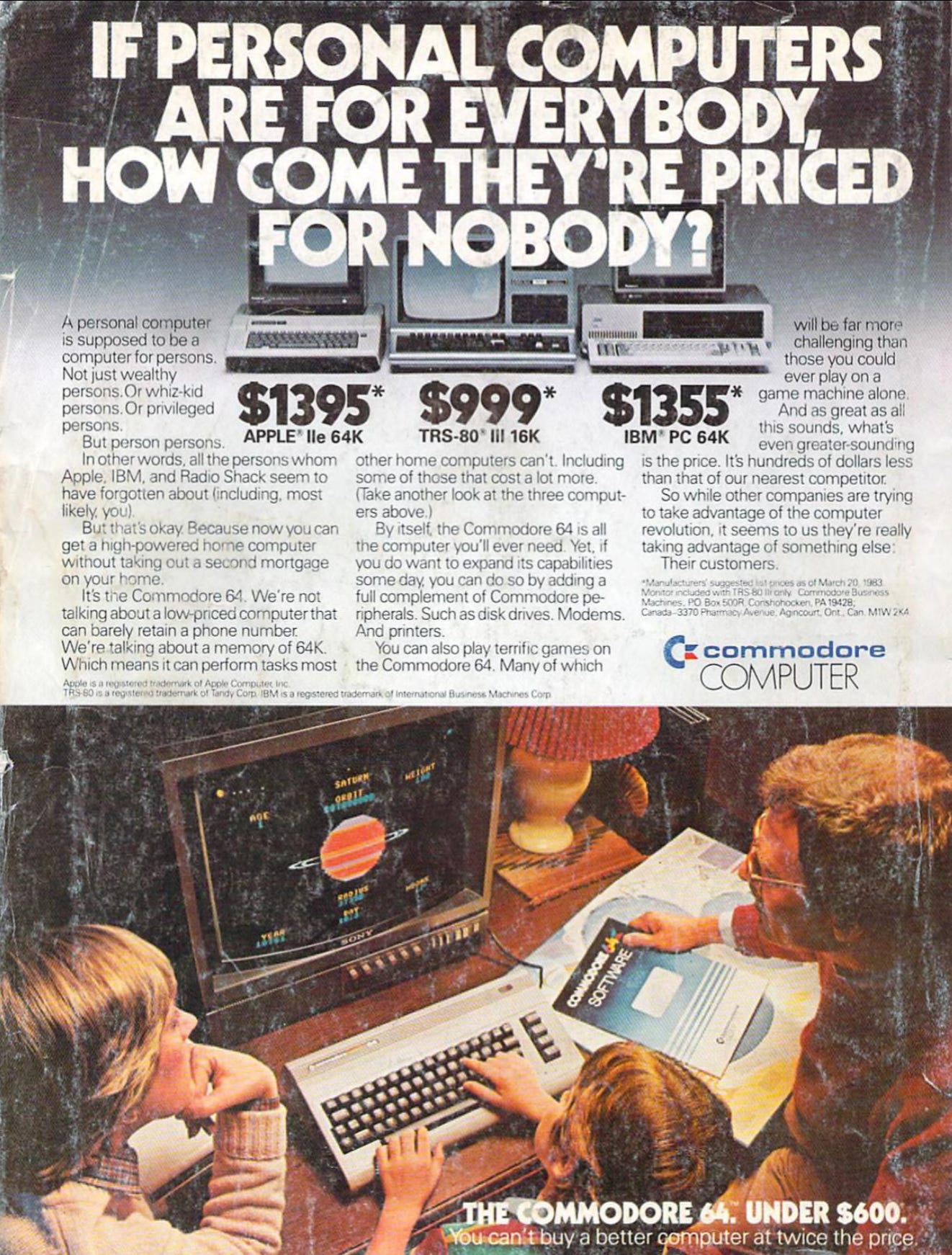
The slogan was on the back page of Compute!, a magazine I often bought from the video game store of the strip mall where my parents operated a gift shop. The advert displayed a trio of competing personal computers on the top half of the page, the Apple IIe, the Tandy TRS-80 III, and the IBM PC, the cost of each machine near a thousand dollars or well above it. The bottom half starred a family of three staring at a computer monitor showing the planet Saturn: mother on the left, father on the right, and the son in the middle with his fingers over the brownie-brown keyboard. “The Commodore 64. Under $600,” the final lines of the ad read. “You can’t buy a better computer at twice the price.”
I sighed, heavily. Six hundred was cheaper than a grand, but it was still six hundred. As a twelve-year-old boy who got paid five bucks a day for helping out the family business, it might as well have been a million dollars.
A month later, I bought the October 1983 issue. Same exact ad on the back, except one enormous difference: “The Commodore 64. Under $300.” Two months later, it dropped under two hundred, an eye-catching $199, at our neighborhood Toys R Us, just in time for Christmas.
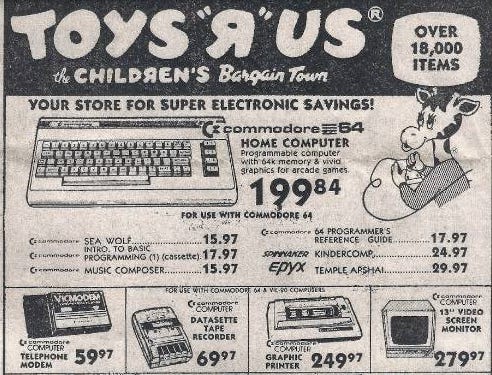
My family and I did not celebrate Christmas traditionally, as we were entirely too busy. For many retailers, Christmas is where the majority of sales happen for the entire year, and we were no exception. The whole month was crazy, but in a good way – at the end of the holiday season, my father would stack the bills on the living room coffee table, and it was like something out of a movie, literal pillars of paper currency. If there was any hope of having my own hands hover over a computer keyboard, this was the moment to seize, right after the new year began, before the household belt tightened again.
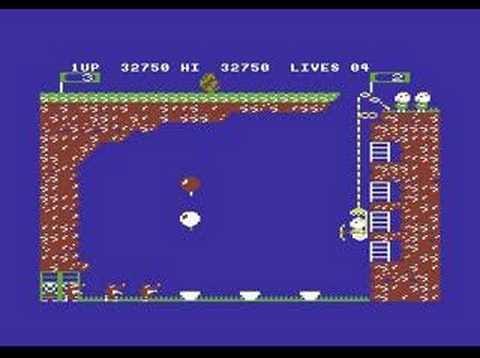
Did I ever seize the hell out of it! The excuse was that I had moved up to middle school, sixth grade, and a computer would enhance my future education. Did my parents buy my story? Possibly, because they bought the computer, plus the Datasette for another seventy dollars. It didn’t take long for my ruse to be exposed, when weeks later, I spent my life savings and forked over thirty dollars for Pooyan, a video game where I played an arrow-slinging mother pig who shot down wolves floating down from the sky on balloons. When my dad saw me unplug the joystick from my Atari 2600 and plug it into my Commodore, he knew he’d been had.
Except this wasn’t true at all. This 8-bit computer with 64 kilobytes of random access memory – to give you an idea how microscopic that is in our now very modern times, my Google Pixel smartphone has a quarter of a million times more space in its silicon brain. This breadbin-shaped plastic box, this fully-functional personal computer that a lower middle class family like ours could afford – if my father were still alive, I’d tell him that the Commodore 64 he and my mother bought for me more than forty years ago has given me a life worth living.
I know that sounds hyperbolic, but holding down a job that pays the bills is as essential as essential can get, and I wouldn’t be a Lead Application Developer for a Fortune 500 company if I hadn’t grasped the rudiments of computing from my C64, and not in the way most people might imagine. I never learned beyond the basics of BASIC, the programming language that came with the computer. Instead, what made me the coder that I am today are the pirated games I played. These games didn’t come with any instructions, so figuring out how to play them was often a bigger challenge than the game itself. That tenacious act of discovery, of trying and failing and eventually succeeding, over and over again, would become my full-cycle programming bedrock. Who would’ve thought unearthing all the keystrokes for Micro-League Baseball would one day lead to developing RESTful web services?
And speaking of baseball, there’s a line about sports in Jay McInerney’s Bright Lights, Big City that speaks to another enormous part the C64 played in my youth:
More and more you realize that sports trivia is crucial to male camaraderie. You keenly feel your ignorance. You are locked out of the largest fraternity in the country.
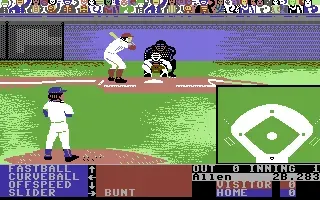
Because the only sport my father enjoyed was golf, I had no help in joining this vast fraternal organization, and even though I watched my New York Mets as much as I could, I didn’t learn the ins and outs of the American pastime until I mastered Hardball! on my computer. Hit and run, curveball versus screwball, the double switch – all the intricacies became obvious when I was throwing and hitting the ball. The reason why I’m able to follow all the popular sports as an adult is due to these sports titles – 4th and Inches, GBA Championship Basketball, Powerplay Hockey, On-Court Tennis. The nickel defense, traveling, icing, the backhand slice: If I was familiar with these terms by watching, I learn them for good by doing on the C64.
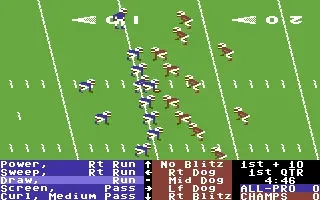
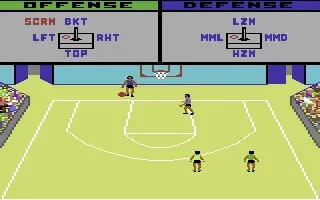
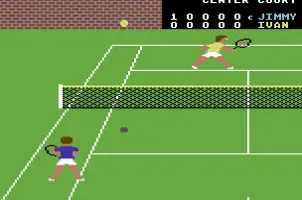
When my aunt who lived in Austria visited us with her husband Josef a year later, we all exchanged hellos with him but not much more, as he could speak neither Korean nor English that well. But then his eyes locked onto my Commodore on the desk next to the couch. He pointed to it and smiled, I pulled over a chair from the dining room, and we spent the next couple of hours in front of the computer we both adored, with joysticks in hand and no need for language. Not long after their visit ended, I received a cardboard envelope in the mail; Josef sent me his favorite games on 5 ¼” floppy disks. It was the first piece of international mail I’d receive.
The C64 expanded my world, not only through my aunt’s Austrian husband but through the local Bulletin Board System (BBS), once I got my hands on the 1660 Modem, connecting our home telephone line to message boards and online chatting. Its speed topped out at 300 baud – roughly 30 characters per second. That’s slow enough that a person could read the words as they ran on the screen, ridiculous to even imagine today, and yet it opened me to stimulating conversations and real people. That’s probably the biggest difference between the online of today versus then, that it was still a local affair, as one only rang BBSes that did not incur outrageous long-distance charges. I was invited to parties where I met my fellow dialers; I attended users group meetings with a guy I met online who became a friend and co-worker at the computer store I’d eventually work at during high school.
And when I wasn’t working or hanging out with friends, I was writing. Spurred on by reading the rich imaginations of Stephen King and Douglas Adams, I started out by writing short stories on the Paperclip word processor. When I graduated to the novel, which I attempted my senior year, I literally came to the end of the line; at some point, there was no more space in the memory of the word processor, so I had to save to disk and start a new document to continue. Eventually, I’d fill two full disks for my first book. The title page read:
Between the Stitches
A Novel
By: Sung Joon Woo
4/14/90
To
5/27/90
When I printed out the document on my dot-matrix printer, which sounded more like a shop tool than a computer peripheral, it was just over 200 double-spaced pages. Closer to a novella than a novel in length, but boy, did it have heft, at least in the physical sense! This is how it ended:
And he slowly pulled on the knob, quietly shutting the door behind him as he walked out into the new world.
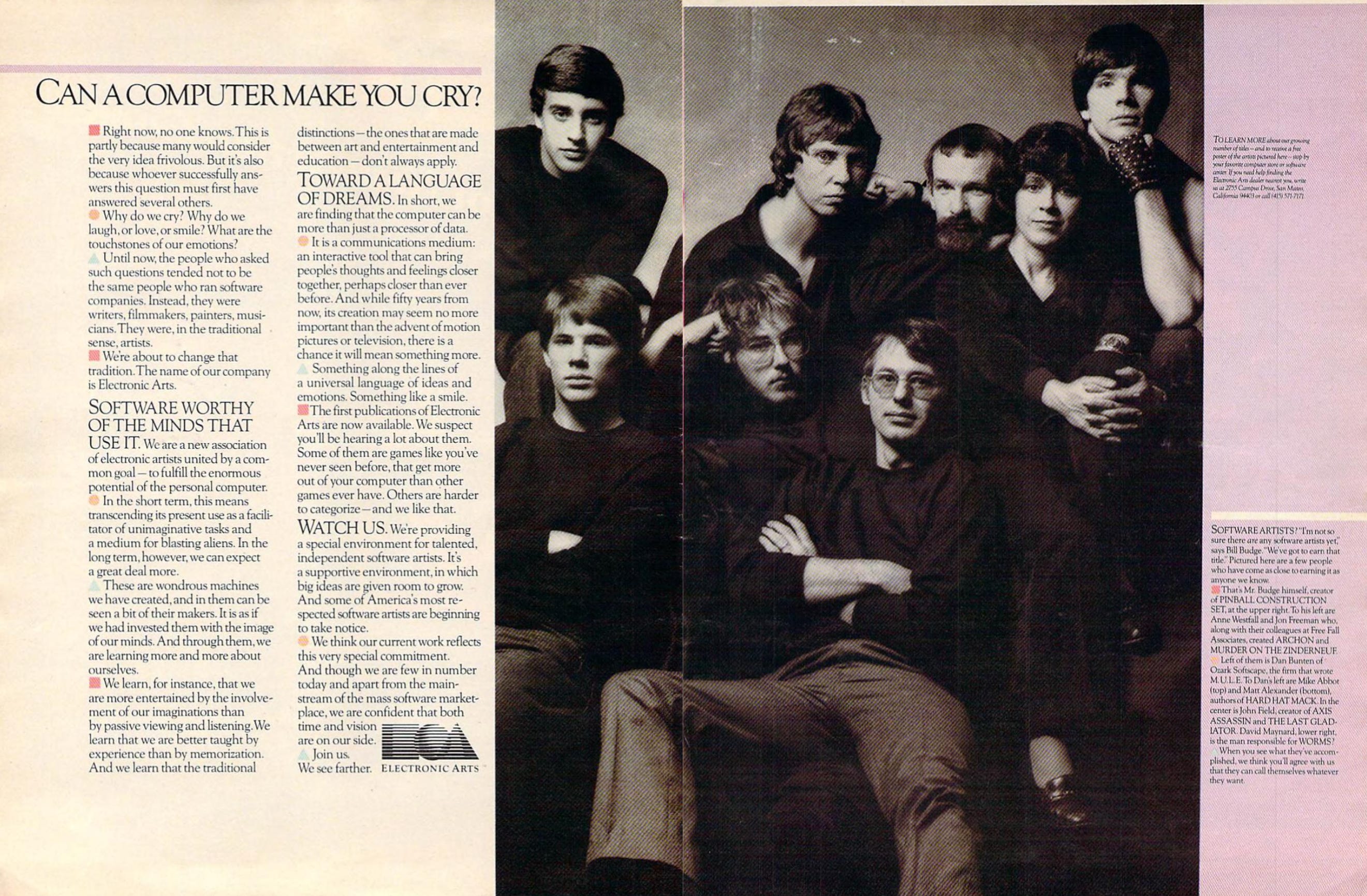
A touch melodramatic? Of course, as it sprung from a fertile and febrile teenage mind. But then again, this was also a time when Electronic Arts, the nascent computer gaming company not yet the titan it would eventually become, featured a print ad that asked, “Can a computer make you cry?”
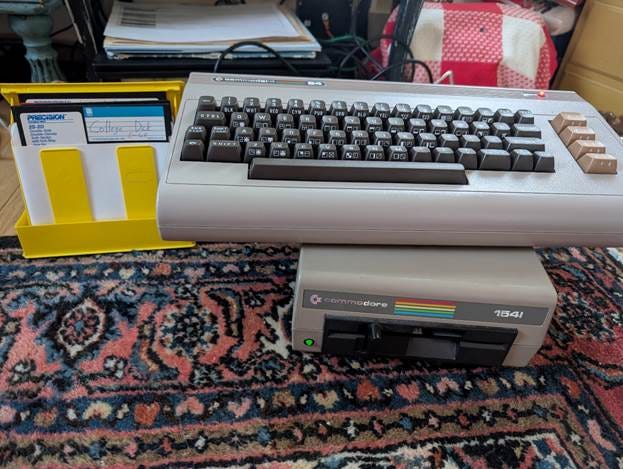
Despite my devotion to the machine, I know I didn’t cry when I let go of my Commodore, because I don’t even remember how or when I got rid of it, decades ago, probably through the local newspaper classifieds. But in 2018, I walked by a retro computer shop and bought the 1541 disk drive, because I kept the floppy disks that contained my early writing. I was able to transfer that ancient data to my PC, thanks to a custom circuit board some genius created, but the thing I remember most was when I flipped on the 1541’s power switch. The sound of the motor kicking up was so instantly familiar that it brought a lump to my throat. More than the sound, I felt the slight stirring of air by my fingertips, a wondrous marriage of analog and digital for my senses.
This is why when an enterprising YouTuber Peri Fractic (real name a much more ordinary Christian Simpson) managed to re-establish the Commodore International Corporation last year, buying up all the necessary trademarks and patents to exactly replicate the old machine with newer technology, I plunked down my cash and bided my time by watching the monthly update videos of manufacture and assembly. Peri promised it would beat Christmas, and he was good on his word, the package arriving with a week to spare. I couldn’t wait to feel my first computer again.
The Commodore 64 Ultimate now sits in my guest bedroom, on the floor, which was where my initial computing experience occurred. Back then it was connected to our television and not an LCD monitor our guests use to stream Netflix, but the vantage point is no different. As a boy, I could spend untold hours in that position, craning my neck to stare at the screen; as a man in his sixth decade, I’ll need to relocate it to a more ergonomic location if I want to keep using it.
Will I? I don’t know. What I do know is that right now, it’s pure joy just to see it there, sitting on the rug, waiting for me to turn it on.
© 2026 Sung J. Woo
Sung J. Woo writes at From Nothing to Something.
You might also enjoy:
My First Atari ST

When I started college as a computer science major in the late 80s, I was still using our Atari 800XL for homework, writing and programming assignments. Although this worked well enough in High School, it was less than ideal for college.
An Atari Origin Story

I recently wrote My First Atari ST and reader Mark Miller chimed in with his own Atari story in a comment to that article, which was both long and interesting. With his permission it is now a main article here on Goto 10 for all to enjoy. Check out Mark’s

I can relate to the story of saving up the money. I saved for my Atari 130XE and disk drive for what seemed like a few years. I saved some of my allowance, and any gift checks I got from relatives. At some point, my mom got a donation from my grandparents, just for it. I think she chipped in a little, as well. We got it when I graduated from high school. Ataris were only available from mom and pop stores, and mail order, then. We ordered from a local dealer. There was some trouble, because they shafted us. They gave me the disk drive, but went out of business before giving me the computer, and left the state. :( We went to an Atari dealer in another town, where I got the computer (so we paid for it twice!). At the time, both the computer and disk drive cost between $150-$200 each.
I loved "Compute!"! I discovered it when I was in Jr. high school, in the school library. I subscribed from 1983 to '88.
Most of the time I spent with 8-bits was in school, or at my local library, where they allowed patrons to sign up for time. Schools had the Apple II. The library had an Atari 400, and 800, and an Apple II. They later added an Apple Mac.
I programmed in nothing but Basic, until I got into high school, where I learned Apple Pascal.
The experience I got from this inspired me to get a computer science degree, and I became a software engineer for several years, working on business IT applications and servers.
These are excellent memories to read about. I had similar memories from those earlier years—the Commodore 64 and its slow, expensive disk drive, which were even more expensive in Portugal. I sold it to help buy a C128, and later did the same for the Amiga 500. However, in this century, I bought a C64 again (along with other old 8-bit computers), but in their original, primitive versions.
My first job was also as a programmer, for an American IT company, using the C language. Curiously, during the job interview, I presented a small country economic model to show my programming skills (just the programming "flow" that I wrote on paper was allowed). The idea came from my memories of coding a similar simulation on the C64 years prior, from a PET program listing in a computer magazine.
Good old years 🙂