Inside the Atari 1200XL
I recently purchased an Atari 800 collection on Facebook Marketplace and the seller was kind enough to throw in a non-working Atari 1200XL that they also had. I’ve never owned or used a 1200XL and was happy to get this fascinating Atari computer that, at least at the time, was a well-known flop.
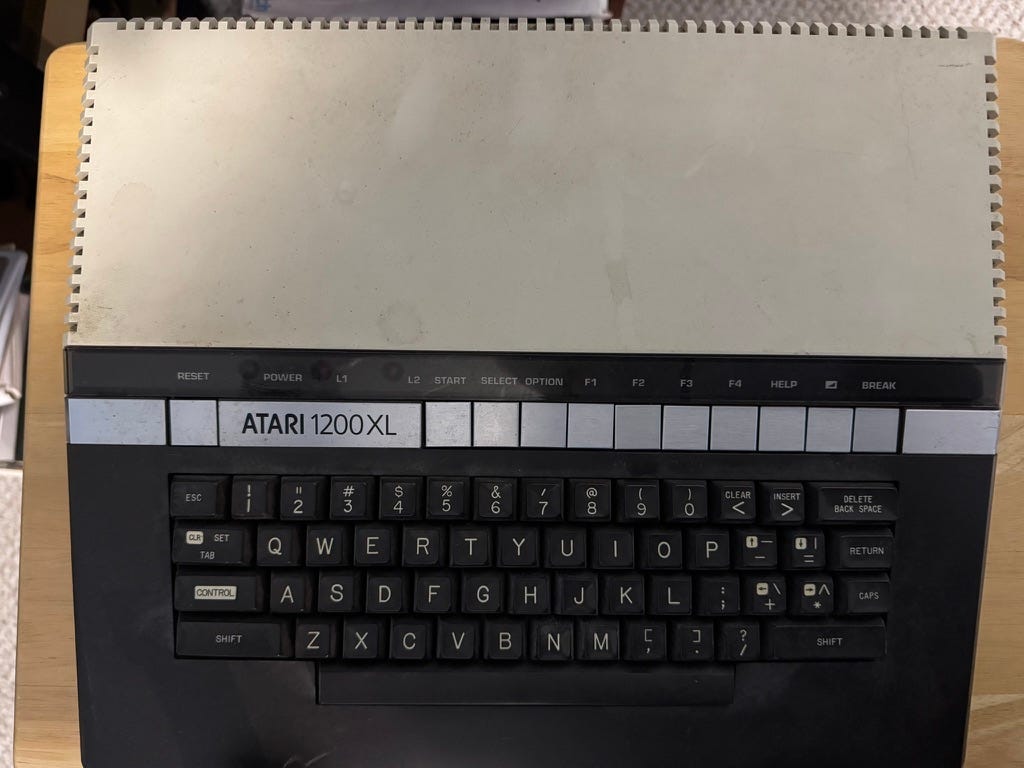
It is obviously not in the best of shape and didn’t even come with any screws to hold the case together, but everything else is here. Let’s take a closer look at this interesting bit of Atari history.
Just looking at the top case, you can see some unique things about the 1200XL. For starters, it has its function keys across the top. Plus, there are extra function keys not seen on any other Atari 8-bit computer: F1, F2, F3, F4. The Inverse key and Break key are also on the function key row. It’s not a bad idea to have break up there, but the Inverse key was used enough that it probably could have remained on the main keyboard.
The keyboard itself has a really nice feel to it. The keys have good feedback and it is easy to type on. It is about as good as the wonderful Atari 800 keyboard, much better than any 800XL keyboard I’ve tried and miles better than the stiff, yet mushy 130XE keyboard.
This is the underside of the top case. You can see the circuit board for the keyboard and not really much else.
Now we get to the main insides of the 1200XL, which contains the rather large motherboard. To be fair, this motherboard is more compact that the 800 design, but it is much bigger than the one that would be used by the 800XL.
Yes, it is dirty. I haven’t had a chance to clean it up or even test it out yet.
On the left side you can see a large plastic hood that looks like a vent, but it is actually the cartridge port. Just below that are two joystick ports, down from four in the 800. All subsequent 8-bit Atari computers would also only have two joystick ports.
That capacitor in the top right is gigantic! Surrounding the capacitor area is what looks like a metal heat sink.
Going back to the main motherboard, here are some of the notable chips:
On the lower right is the 64K of RAM.
Near the center, at the U23 location, is the 6520A Peripheral Interface Adapter (PIA).
Above that, at the U21 location, is the infamous MOS 6502C CPU.
To the right of the CPU, at location U19, is the Atari GTIA (Graphics Television Interface Adapter) chip. It works in conjunction with the ANTIC chip to handle the amazing Atari 8-bit graphics.
Speaking of the ANTIC, it is located below the GTIA at U20.
To the right of ANTIC, at location U24, is the POKEY chip (POtentiometer/KEYboard integrated circuit).
Above POKEY are the OS and BASIC ROMs.
Overall, the motherboard is nicely laid out. Below are close-ups of the left and right sides.
On the outside left you can see the cartridge port and joystick ports. The cartridge port was a tight fit and some older Atari 800 cartridges would not fit in it.
The usual ports are in the back, which includes the SIO (Serial IO), RF output, monitor output, channel selector and power connector. The 1200XL uses the same power supply as an Atari 800.
I’m told the 1200XL does power on, but that there is no video. Right now it is in two separate parts. There are two ribbon cables on the top case that need to be connected to the motherboard.
This 1200XL is now my first “project computer”. I have the 1200XL Field Service manual and will be reviewing that to hopefully identify what I need to test and perhaps even figure out what needs to be fixed.
Be sure to subscribe so you don’t miss future articles about this 1200XL.
And if you liked this this short tour around the Atari 1200XL, you’ll probably also like these:
The Atari 1200XL Fiasco
The Atari 1200XL was the third Atari 8-bit computer. Announced in late 1982 and available in early 1983, it was designed as a replacement for the Atari 800, which was becoming increasingly expensive to produce, and to serve as a better competitor to the upstart Commodore 64.
Inside the Atari 800XL
The 800XL was the Atari 8-bit computer I used the most so I’m happy to have my own 800XL now, although it is sadly not the actual one I had as a kid. This one is a later model (probably from late 1984) because it has the Rev. C BASIC built-in, which is the latest the one without known lock-up bugs. This 800XL is not modified in any way. If you zoom in o…


