Introduction of the Atari 400/800 in 1979
I wasn’t there at the time, but it must have been amazing when the Atari 400/800 were both introduced in late 1979. At that time, the primary personal computers were the TRS-80, Commodore PET and the Apple II. The Atari computers may have seemed similar, but they were just so much more advanced, in nearly every way.
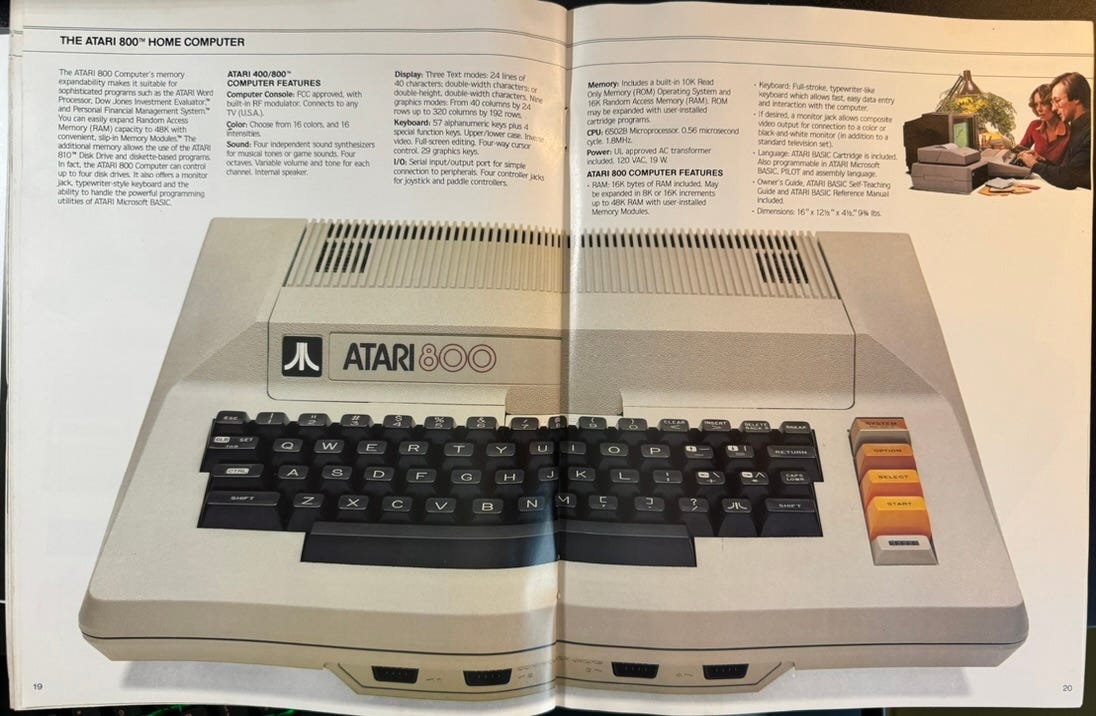
To be fair, the other, older computers did have some advantages. The Commodore PET was an all-in-one computer, which I’m sure had some appeal. After all, that made it easy to set up: just plug it in. The monitor, computer and cassette were all integrated.
The TRS-80 had a somewhat low price and was readily available at thousands of Radio Shack stores throughout the US. This gave people an easy way to see the computer in action before buying it.
The Apple II could be easily upgraded and expanded with its many slots.
But the Atari computers were even better, with many impressive innovations.
First was graphics. Originally they had 128 colors, 16 colors with 8 levels of luminance. The TRS-80 and PET did not have color at all and the Apple II had just 16 colors in total. A couple years later, the CTIA chip that provided colors on the Atari was upgraded to the GTIA which could provide 16 levels of luminance for a total of 256 colors! The Atari computers also had a wide variety of graphics resolutions up to 320x200, instead of just the hi-res and low-res of the Apple II.
The Atari computers had sprites (although Atari called them player/missile graphics), which made for smooth, moveable objects in games, among other uses. The PET, TRS-80 and Apple did not have sprites at all.
For peripherals, the Atari used a single serial IO port (SIO), which was plug and play. Peripherals could be daisy-chained and could be plugged in or unplugged while the computer was on. The other computers had different ports for different peripherals. At the time, Apple II drive cables plugged into cards installed inside the machine. Unplugging one while the computer was on could fry everything!
In fact, the Atari SIO port might sound familiar to you because several people that designed it also worked on what became the USB (Universal Serial Bus) standard in the 90s. In some ways, the Atari SIO was a primordial USB.
The Atari had several ways to load software onto it. There was the cassette, which what the other computers also had at this point, but it also had a floppy drive, which was somewhat new at the time. The PET’s floppy drives were huge and slow. The Apple II drives were fast and somewhat small. The Atari floppy drive was in the middle.
But with an Atari computer you could also use ROM cartridges for instant access to software. With a ROM cartridge you did not have to wait forever for a cassette to load or deal with a disk drive, floppies and DOS. ROM cartridges did have the downside of giving the Atari a bit of a game machine image, since cartridges at the time were primarily associated with game machines such as the incredibly popular Atari VCS.
The killer app for the Atari computers was Star Raiders, a cartridge with an impressive 3D implementation of the popular text-mode Star Trek strategy game. The star field whipping past you as your ship flew through space must have been a site to see in 1979, just two year after Star Wars!
Unfortunately, as great as Star Raiders was, it also had a hand in the Atari computers being considered game machines. Many early cartridges were games and most people only knew the Atari name from its VCS game console. This, combined with the lower-cost Atari 400, led many people to believe the Atari was only really good at games.
This was despite the fact that programs such as VisiCalc, the famous spreadsheet that was the killer app for the Apple II, was also ported to the Atari.
But even though you could run VisiCalc on your Atari 800, people seemed to prefer the Apple II for productivity programs. Even though the Atari also could have up to 48K of RAM, I think some of this was because it was easier, and perhaps cheaper, to add 80-column support to an Apple II, especially if you were already using the necessary monochrome monitor.
Atari computers were often used with TVs and color monitors, which really couldn’t handle 80 columns. And even though you could add an 80-column card to an Atari 800, it did require you to get a monochrome monitor, which Atari didn’t sell. And because the expansion slots in the Atari 800 were used for the full 48K RAM, you might not have had an open slot to use unless you bought a higher capacity 3rd party card to free up a slot, which could be pricey.
So even though the Apple II cost much more than an Atari 800, it ended up being the preferred computer for productivity uses, at least until the IBM PC came out.
But Atari still had the game market locked up, at least until 1982 when the Commodore 64 was introduced. The C64 was designed to be a low-cost home computer and it competed very well with the Atari 800 in the areas that mattered to most people.
The C64 had more RAM (64K) than the Atari 800 (48K), it had more sprites, better sound, was smaller and cheaper. It didn’t have as many colors (only 16), but it made it easier to get those colors on the screen at once. The Atari required trickier programming to get more than a handful of colors on screen at the same time.
When Commodore started dramatically cutting the price of the C64, Atari was left in a pickle. Its Atari 800 was expensive to manufacture and cutting the price would eventually lead to a loss with each sale. Keeping the price high would have meant competing with the Apple II. Atari decided to cut prices to compete with the C64 and produce a new computer to replace the Atari 800.
Unfortunately that computer, the Atari 1200XL, was still expensive and large compared to the C64. It flopped and was discontinued in less than six months. It wasn’t until the 800XL was released in late 1983 that Atari had a viable competitor to the C64, but by then it was too late for their 8-bit computer line to recover. It stuck around for many years afterwards in 3rd place, the RC Cola to the Commodore and Apple’s Pepsi and Coke.
Still, the Atari 8-bit computers had a long life, being produced from 1979 up until 1992 in a variety of models: Atari 400, 800, 1200XL, 600XL, 800XL, 65XE, 130XE, 800XE and XE Game System (which was marketed as a game console, but was also a full 8-bit computer).


