
The History of Swinth
The graphics were cool, but the tunes? It didn’t seem possible that such lush music could come out of a Commodore 64.

Enjoy this guest post from Sung J. Woo! — Paul
Do you remember Swinth? That may not be the filename you typed to load it and run it – the copy I have on my floppy is from 1988, and it is misspelled: SNYTH. But it runs just the same.
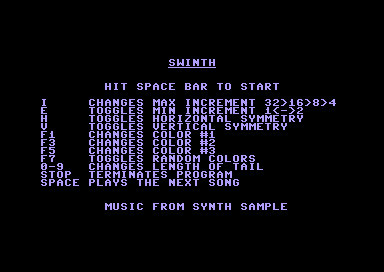
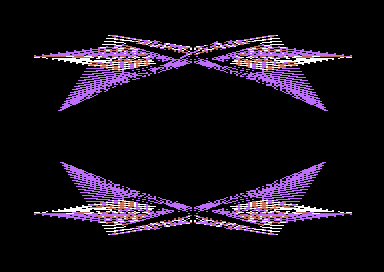
Light Fantastic was another name Swinth went by, and it is an apt descriptor, though a better one might have been Music and Light Fantastic, because as impressive as its proto-screensaver graphics were, the music is what people still talk about to this day.
An easter egg exists if you type LIST before running it, displaying the people responsible for this landmark demo. Glen E. Bredon created Swish, the graphics portion. Jim Winings uploaded the music. Carl A. Meahl Jr. figured out how to put the two programs together.
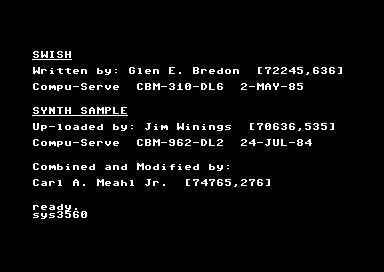
Note that a significant name is missing, that of the composer of Synth Sample.
Through the vagaries of the internet, I was able to track down Carl “Butch” Meahl, Swinth’s author, and the composer of the wondrous music, too: Georg Feil. Dr. Bredon and Jim Winings are unfortunately no longer with us.
Here now is the story of Swinth from its living creators, in their own words.
Georg Feil, author of Synth Sample: My twin brother Max and I got our C64 at the end of 1982. I remember seeing the famous Christmas Demo in the store. But we had owned a PET computer for a few years so we knew and loved Commodore computers already.
I started developing Synth, which was used to create Synth Sample, in 1983, so 43 years ago. I’m 62 now but still play keyboards around various venues in Toronto in my band. My goal in 1983 was to make my computer play some of the music I really loved, like Vangelis. I was not a musician but fortunately making Synth led to a part-time career in bands and music. I had actually attempted making music on my PET computer a couple years earlier. I wrote a program called Composer, but with no SID chip it could play only one note at a time and I realized this was too limited. Another important goal for Synth was to be able to export the music and “attach” it to other programs easily, so that game developers could use it as a music and sound-effects workstation then integrate the results into their game.
Butch Meahl, author of Swinth: Well, I had just gotten out of the Navy. And in the Navy, my last tour of duty was in Millington, Tennessee as an instructor. I taught machine language in the Navy “A” schools, and I was in the computer lab. That’s where I got my start with actual machine language and processors. The first thing I did was buy a Commodore 64.
The first program I bought was the Macro Assembler Development System. Then I signed up with CompuServe, an old bulletin board at the time. And I started downloading programs and disassembling how they worked.
One of the programs was Synth Sample. It was a program that ran in the background so you were able to run other programs in the foreground. While that music was playing, I got on CompuServe and browsed around and downloaded other things.
A few months later, Swish came out.
Cameron Kaiser and Matthew W. Miller, via comp.sys.cbm on July 26-27, 2000: I read in comp.sys.apple2 that Glen Bredon died. He was the author of, among other things, the Swish demo that was eventually incorporated into Swinth, and tons of other utility programs for both the C64/128 and Apple II systems. Originally, Swish was included with Merlin 128 and was a demo of a fast line-drawing routine he had developed.
Terry Winings, younger brother of Jim Winings who uploaded Synth Sample to CompuServe: Jim lived in Ft. Lauderdale and I lived in Chicago then. He had a software company he called Winning Edge Software. We both worked for Motorola then and they had a quality improvement initiative they called “First time yield.” Jim’s program was to measure that. I believe he may have sold it to a couple of companies. It didn’t go much beyond that, but he had great hopes. He had a Commodore 64 and IBM compatible PC. He would have been thrilled to know someone was interested in his efforts.
Georg: I didn’t know Jim Winings. My brother and I were at University of Waterloo, in residence. There was a lot of file sharing going on in residence, students with C64s became friends and would visit each other’s rooms with floppy disks. After I made Synth Sample I gave it to a friend in residence named Paul Kellam. He was an expert C64 coder and hacker and probably had a lot of contacts through his game hacking activities. He was particularly interested in C64 music, and later even “commissioned” me to create a Synth song for him – the Hogan’s Heroes theme. After I gave it to Paul I have no idea how Synth Sample spread. I hadn’t even put my name on it as I was just giving it to my friend. That must have been early 1984, then in the summer of 1984 I was on a co-op work term in Ottawa and went into the conference centre for some kind of computer exposition. There I heard Synth Sample coming from multiple C64s in the big hall. That was the first time I realized it had gone “viral.”
I designed Synth to be able to play multiple sound effects/songs at the same time using the SID chip’s 3 voices, just with a few SYS calls. For example, a game could easily play music using two voices, and sound effects using the third voice. This is one reason that Synth works completely in the background. My brother Max wrote a game called Space Pods and used Synth for all the music and sounds. Unfortunately, despite some conversations and meetings with software companies, Synth never became an actual product that people could buy and use for composing or games. Synth Sample itself was created as an example of how Synth could automatically attach music to any program.
Butch: I started playing around with Swish and Synth Sample together, running them through the disassembler. I got the source codes for both programs and modified them because they loaded in different areas of memory. It took about three or four months; I disassembled the two files and studied them in detail. Swinth was a precursor to multi-tasking. You were playing music in one program, and the graphics in another program, and you had to get the interrupts right for them to work together. I’d put Swinth through my stereo, and my TV, too. I had a big 36-inch CRT TV!
Georg: I was 16 when I got into the PET computer and wrote a heck of a lot of PET software. By the time the C64 came out and I turned 19, I had a lot of experience programming Commodore computers. The key step was learning 6502 assembly language. The Synth “executor” which plays the music (the invisible part of Synth Sample) is 100% assembly language. It’s hard to say how many hours it took to create Synth, because for me it was so much fun and I was also creating music with it as soon as Synth was even partly working. So a lot of the time was actually spent making music, not writing code. The most annoying part was creating the Synth user manual/online help system. There’s a lot of documentation built into Synth, a whole interactive user manual. I wrote a specialized text editor program and then used it to write the documentation. I remember that while writing the documentation I would go to bed and still be typing sentences in my sleep.
Butch: I never knew the two gentlemen that created Swish and Synth Sample. I tried getting their permissions to go ahead but they never responded. So I just made sure I put their names out there along with the program, so that way, everybody knew where the two programs came from. They were members on CompuServe. My user number there was 74765,276. I typed that in so many times! A number like my social security number embedded in my mind. CBM-310-DL6 and CBM-962-DL2 were the file identifiers on CompuServe that I downloaded to create Swinth.
Georg: Synth Sample itself was very fast to create. As I’ve mentioned, Synth was designed to attach music/sounds to other programs, and I had already made a bunch of music in Synth, so making Synth Sample was just writing a bit of BASIC code and running Synth to automatically attach the music. Creating the music was not a fast process though. As a non-musician I was learning about music, training my ear to recognize different notes and chords, experimenting with sounds on the SID chip, developing Synth software, and transcribing my favorite music all at the same time. At least musically I was just a beginner.
Some comments regarding the songs I chose to include in Synth Sample.
Stationary Ark, by John Mills-Cockell – you would not believe the long road this tune has had to get here. A brilliant old friend of mine (Tim Donnelly) played this live on C64 using my software, I transcribed his performance from a cassette recording with no reference to the original composition by John Mills-Cockell. Tim never mentioned where he got it from. I filled in some gaps and incorporated it into Synth Sample, where it was known as Tim’s Song until others traced the origins. Later, John Mills-Cockell friended me on Facebook unprompted. I asked him about a recording of his original soundtrack. I got back a fairly vague reply that implied even he does not have a copy of the recording.
Saturdays in Silezia, by Rational Youth – a fluffy pop song I taped off the radio. Seemed simple enough to render on the C64.
Tubular Bells, Part 1, by Mike Oldfield – I just thought this was ultra cool. Used as the music to The Exorcist, unfortunately.
Magic Shadows (closing theme), by Harry Forbes – it was a half-hour movie show on TV Ontario, sort of the Canadian equivalent of PBS. They’d show old movies in half-hour installments. I have no idea if there’s an album. I taped it off the TV.
Butch: Oxygene 2 (from Oxygene), by Jean Michel Jarre – the best song I like from Swinth is Oxygene 2. I bought Jarre’s album when it first came out in the 70s, and I’ve played that album to death!
Georg: Canon in D major, by Johann Pachelbel – a very popular classical hit. I transcribed the notes from a Transactor or Compute! article (the only Synth Sample piece not transcribed by ear).
The other songs by Rational Youth and Vangelis were just what I was into at the time. Over the years I’ve gotten many thank-you emails from people telling me Synth Sample helped them discover the original versions of this music.
Butch: I was unmarried, which is why I was able to work on Swinth. I just started working at the Postal Service in Clarksburg, West Virginia. I kept playing with the Commodore 64 for a couple of years. In the Postal Service, I was electronics tech and took care of the computers. That’s when I started with IBM PCs and Microsoft DOS. Which was basically when the Commodore 64 was retired. Now, I still have it up in the attic along with all the disks and everything. I probably still have the source code for Swinth.
I’m retired now. I spent 32 years with the Postal Service. My wife and I bought an RV in 2024, and the first thing we did was drive out to California. We’ve got 23 states under our belts now, so we’re almost halfway through. We’ve done all the southern states, from Florida to New Mexico, California, all that. Now we’ve got to do the northern states. We just want to see the whole country.
I never imagined Swinth going the way you’ve told me – I’ve looked it up online, and yeah, there’s a lot of stuff out there. I’m amazed!
Georg: The C64 had a huge influence on my life. It led me to become a musician, and make many life-long friends (most of them musicians). It taught me how computers work, helping me on my career as a software developer and computer science professor. I’ve met many great people as a result, from random strangers talking about Synth Sample to work colleagues who also used the C64, and of course Jim Butterfield who actually figured out who made Synth Sample. In the current horrible age of AI the C64 is the happy place I go back to.
For the last few years, I’ve been running the Sheridan Robotics Club where we use things like Arduino and ESP-32 which are really fun and have a lot of the spirit of the C64.
Synth (the Synth music editor) is still available for download on the Commodore Scene Database. The text “code” files used to create the songs in Synth Sample and a bunch of other songs are part of it: https://csdb.dk/release/?id=57436
Thanks to Butch Meahl, Terry Winings, and Georg Feil for conversing with me, and to the Wayback Machine’s archive of HardSID.com, whose page on Synth Sample compiled some of Georg’s song comments contained in this article.
© 2026 Sung J. Woo
Sung J. Woo writes at From Nothing to Something.
 | A guest post by
|