

John writes about a wide variety of topics on Substack.
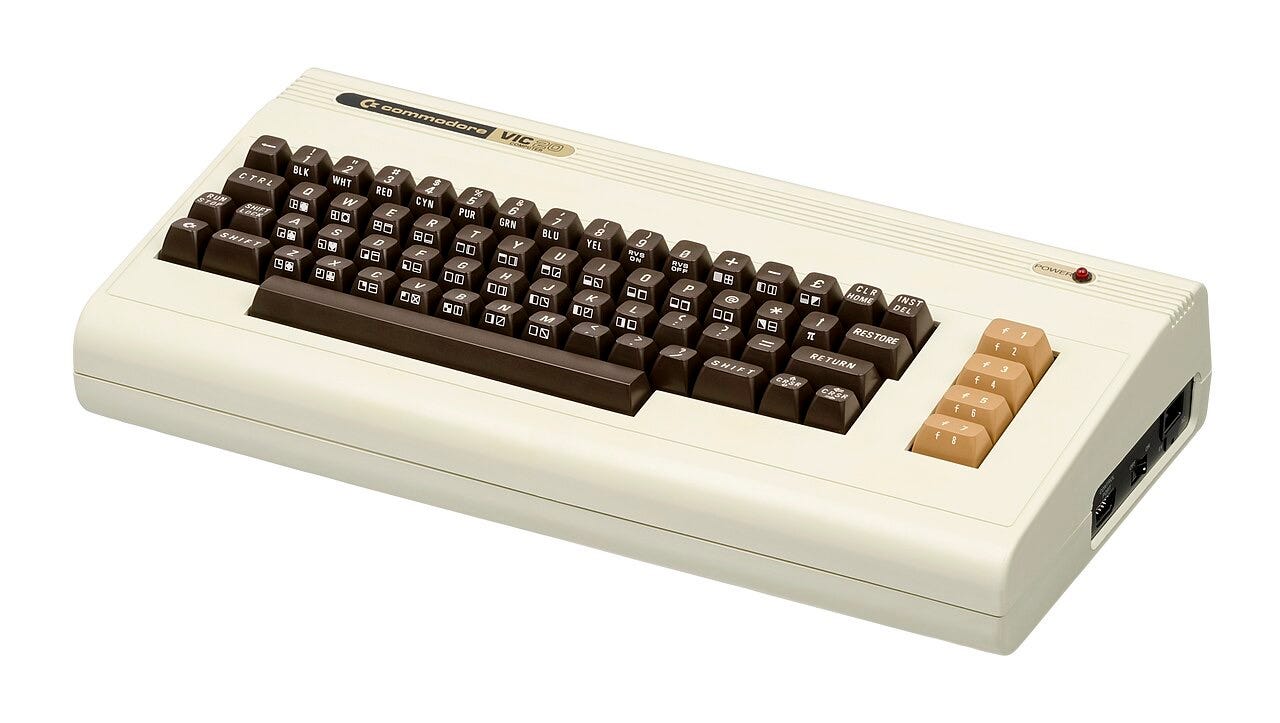
Christmas 1981 still stands out as one of my favorite memories. I was nine years old and about to unwrap one of the best hauls of my childhood. Some of my favorite presents from that year were Mighty Men and Monster Maker1, a nine inch Remco Dracula2, and, best of all, a Commodore Vic-203.
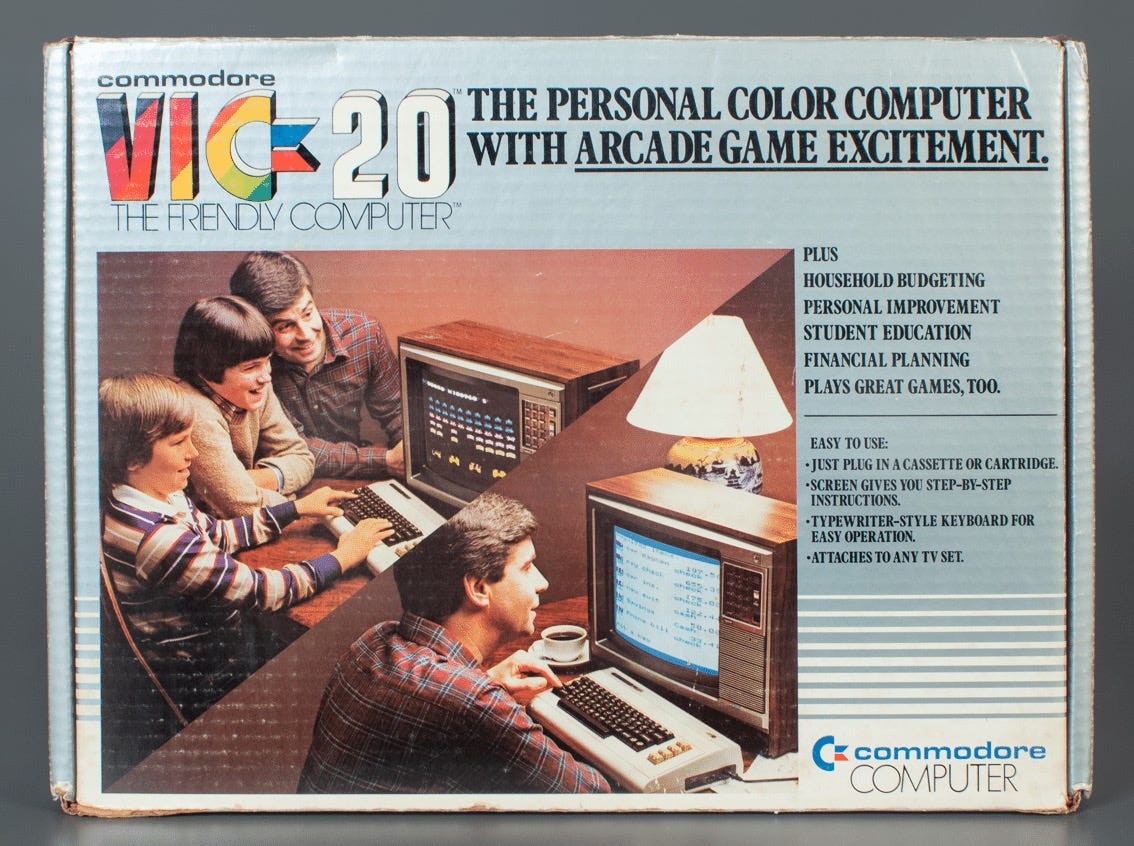
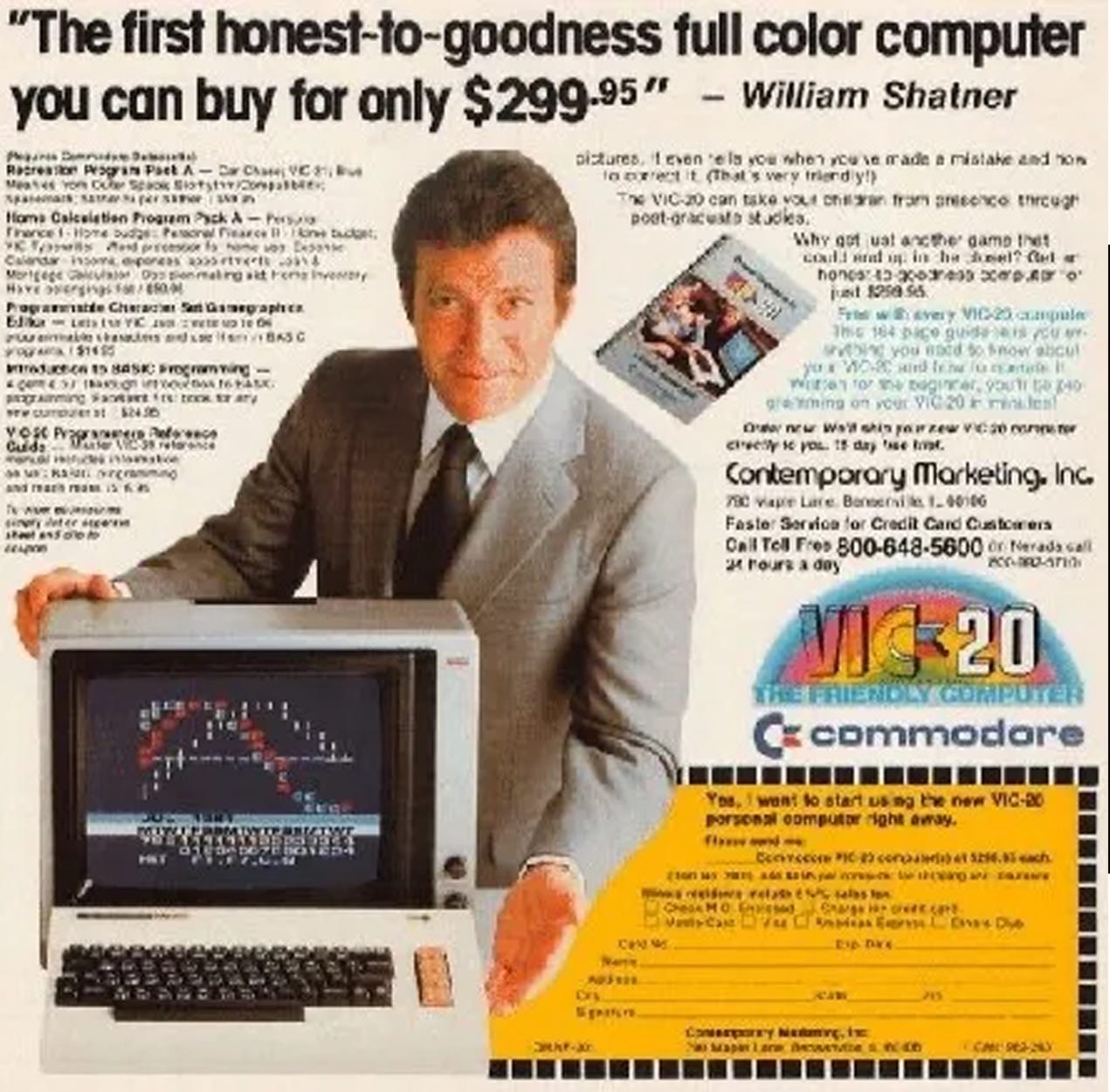
The man I recognized as Captain Kirk (William Shatner) was all over TV telling America how affordable the Vic-20 was4. Computers were the future. Everyone knew it. That was an unquestioned truth that adults repeated so many times that even a young kid like me absorbed it.
I already owned an Atari 2600, and I still loved playing Pitfall and Asteroids (Adventure had been my favorite, but I’d beaten it long ago). A computer felt different though. A game console was for entertainment. A computer was for learning. All of the adults said it would teach me the skills that would one day lead to a high-paying job in the coming information age.
The problem was that computers didn’t teach you anything. They merely gave you the opportunity to learn. They also gave you an opportunity to play new games that didn’t exist on the Atari, and for the first several months that’s exactly what I did.
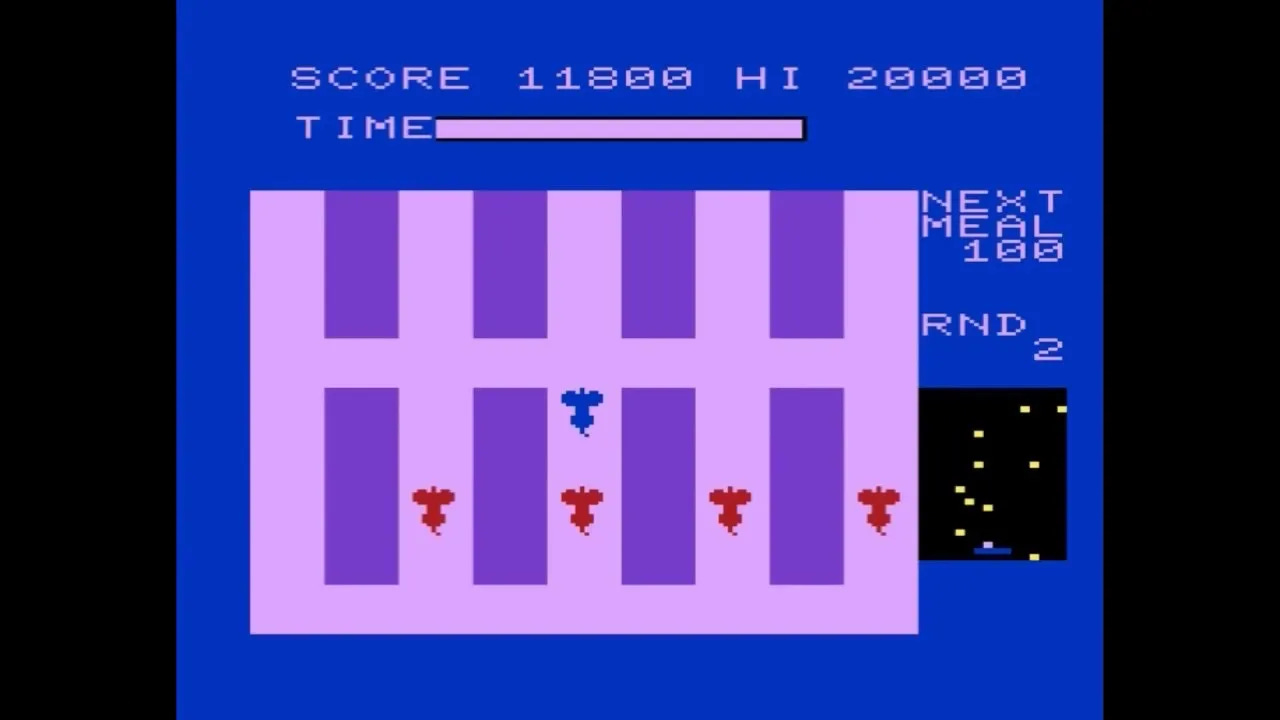
I think the Vic-20 I received came bundled with Radar Rat Race5, although my parents may have bought it separately. Regardless we had a lot of fun running through those mazes. The other standout game was Scott Adams’ Adventureland6. It was an early text-based adventure with a two word parser. Eventually, though, even those games became familiar, and I longed for something new.
One day, I decided to open the Vic-20’s User Manual. Part of it was devoted to BASIC Programming. And just like most kids in the early eighties, I carefully copied the simple program7 that caused the screen to cycle through its colors in a seizure-inducing blur.
What happened on that screen wasn’t particularly impressive, but the realization that I had made those colors appear because of what I had typed was a revelation to me. For the first time I understood that computers weren’t just machines for experiencing worlds other people had built. That little beige box could become a tool for creating a world of my own.
From there I graduated to PEEK and POKE. I used them to draw simple images. I never got very far with graphics, but I quickly discovered what IF… THEN and GOTO could do together. Once I understood that I could use those to create a program that could ask a question and branch to different outcomes, I realized I could build my own text adventures. I had never before heard the term “spaghetti code,” but I was about to write a lot of it.
None of my games were especially complicated, and they probably weren’t very good. That wasn’t the point. The important lesson was that these strange boxes weren’t just for consuming what someone else had made. They could become workshops. I could use them to build worlds that had existed only in my imagination.
And then one day all of my new found creative powers came to an abrupt end.
I was happily copying a program from some computer magazine of the day when the TV screen went blank. The cyan border that had become as familiar as an old friend on the Vic-20 disappeared, replaced by nothing more than a flickering gray field on our RCA television. No cursor. No “Ready” prompt. No indication that anything was waiting for me to act. Just a lifeless screen.
I didn’t know what had happened. Then I noticed the power light on my computer was dark. I flipped the switch, but nothing changed.
Eventually, I admitted defeat and asked my dad if he could help me figure out what was wrong. Together, we opened the machine and he instantly spotted the problem. The Vic-20 had blown a fuse.
He told me he’d look for a replacement the next time he went into town. I waited.
And waited.
Eventually, we learned that Radio Shack didn’t have one in stock. The store owner ordered a replacement, but it wouldn’t arrive for another three weeks. Next-day delivery wasn’t really a thing normal people could afford in the eighties. Sometimes you just had to wait.
And so I waited. Waiting was difficult because I had just discovered the joy of making things.
I spent the time the best way I could. I committed my ideas to paper. The next game was going to be my most ambitious yet. Every extra day without the computer gave me more time to imagine it, and by the time I finally finished designing it in my head, I was certain it would be my best game ever. Maybe even as good as anything Scott Adams had ever made!
Eventually, the day came when we went to get the replacement fuse. Only they’d sent the wrong one.
Another three weeks.
I went home disappointed, but at some point during that wait an idea began to form. The only thing preventing my Vic-20 from working was a lack of conductivity. What if I fixed that myself?
As a child I’d done experiments with nine volt batteries and had already learned something about aluminum foil: it was a great conductor. If I wrapped the fuse in foil, I could make the connection work. I could have my computer up and running again any time I wanted. That would allow me to type in my game, save it to cassette, and then shut everything down until the proper fuse arrived. It was a perfect plan.
It worked… for a while.
The Vic-20 powered on, and I began typing. For several hours everything was exactly as I’d hoped it would be. Then, halfway through typing it in, that familiar flickering gray screen came back.
Only this time there was something different. There was also a smell. It reminded me of burnt toast.
I didn’t wait for my dad this time. I opened the machine myself and found the problem. The aluminum foil had blackened, and the motherboard was the source of the smell. My attempt to save my computer had destroyed it. Needless to say, repairing my Vic-20 was now going to require a lot more than a replacement fuse.
It was another two years before I had a computer again. This time it wasn’t a Christmas present or a surprise gift. I was expected to earn it. By then I was twelve years old. We’d moved into a house on a hill above a dirt road, and we heated that home with wood. My dad had ordered a truckload of logs, and they were dumped into the culvert between the hill on which our home stood and the road.
He made me a deal. If I split and stacked all of that wood, he’d buy me a new computer as payment. I agreed. He cut the logs into pieces that would fit our stove, handed me an axe, and I got to work. It took the entire summer, but when I had finished I’d earned my computer: a Commodore 128, the 1902 monitor (supported both 40 and 80 column modes!), and the 1571 floppy drive.
It’s almost been half a century and I’m still using computers to make imaginary worlds. The tools have changed. The Vic-20 has been replaced by machines whose capabilities would have felt like something from Star Trek when I was a child, but the feelings of curiosity and wonder are still the same. I still get just as excited by the possibilities.
That excitement has led me to create artwork for gaming companies and self-published authors, often combining traditional drawings with digital painting on a Wacom graphics tablet. I write fiction on a Mac and publish stories through my Substack. The machines are more powerful now, but the magic remains the same.

Footnotes
I wanted to include the commercial because it shows how cool this was:
I couldn’t find commercials for the individual 9 inch figures, but you can see them in this commercial:
This commercial captures the attitudes and implied fears of the time:
These commercials seemed to air non-stop back then:
This was peak computer gaming in 1981-82:
The Wikipedia entry gives you the basics, but I also enjoyed this write-up of the game.
If you have access to a Vic-20, type this in and enjoy! You’ll need to type the Run command to execute the program.
10 FOR X = 1 TO 255
20 POKE 36879,X
30 FOR T = 1 TO 1000:NEXT T
40 NEXT X
