

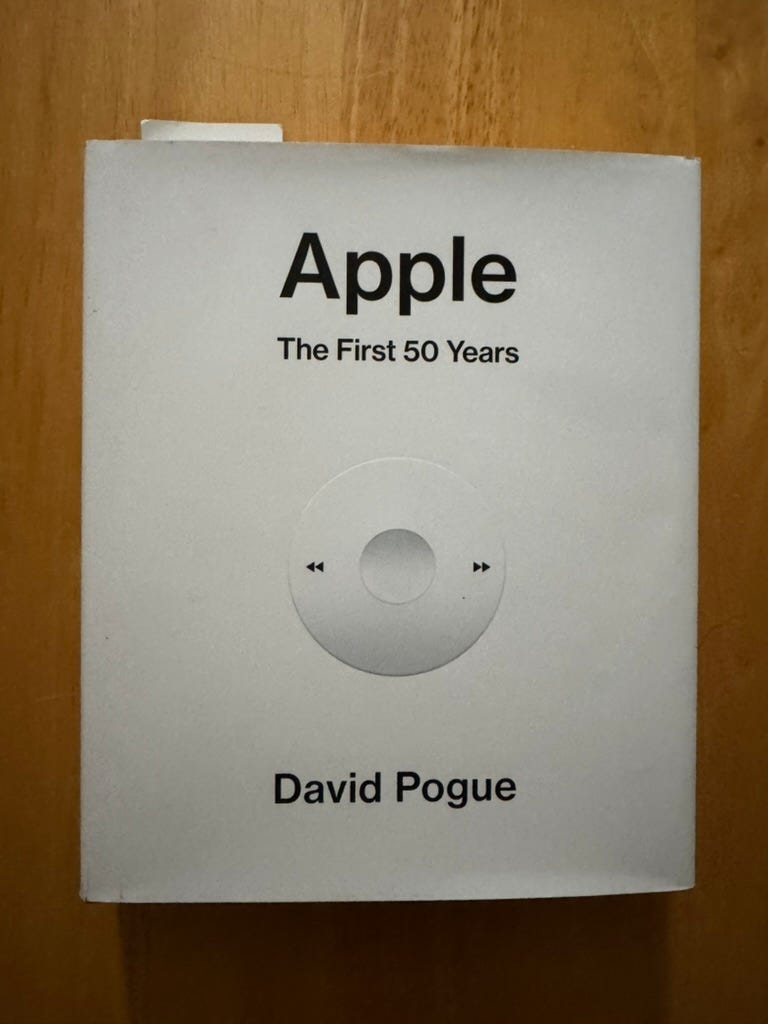
Last month I read Apple: The First 50 Years by David Pogue and really enjoyed it. I’ve read many biographies about Steve Jobs, but I liked learning more about Apple as a company. In particular, I enjoyed the little nuggets of Atari references that were spread throughout, although mostly in the early years.
Let’s take a look at some of these Apple and Atari connections.
Breakout
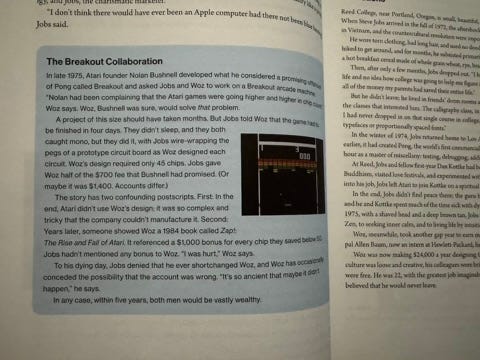
Steve Jobs actually worked at Atari for a hot second and the first mention of Atari in the book covers the story about the Breakout game. As the story goes, Nolan Bushnell tasked Jobs with creating Breakout and Jobs in turn brought Woz to do the actual work on the board. In the end, Woz came up with a clever design that used far fewer chips than expected, but Atari did not end up using it.
Apple Company Name
Before naming themselves Apple, several other names were considered for the fledgling company. The name Apple was a good choice, but according to Jobs another bonus of that name was that it “would get us ahead of Atari in the phone book”. That may seem silly now, but in 1976, Atari was a large and growing technology company that definitely loomed over Apple.
Ron Wayne
Not many people know about the 3rd founder of Apple: Ron Wayne. That’s because he only stuck around for a couple weeks before selling his share back to Jobs and Woz. The connection? Jobs had met Wayne when they both worked at Atari.
Atari Declined to Loan Apple Money
Needing cash to buy the components for the Apple I, Jobs went to everyone he knew asking for loans. He needed about $10,000 (approx. $58,000 in 2026), and even went to his bosses at Atari but they turned him down.
The Apple II Power Supply
Another guy that Jobs knew from Atari, Rod Holt, designed the switching power supply for the Apple II, notable because it ran cool, was small and relatively low-cost.
Apple II Color
The original Apple I did not have color. Neither did the TRS-80 or Commodore PET. The Apple II did have color and Woz used an idea he came up with while working on the Breakout game for Atari. Basically, the Apple II output color by adjusting the timing of the video output to hit parts of the RGB phosphor in the CRT. This technique didn’t provide a lot different colors, just six colors actually, but that is much better than black and white!
Apple Offered to Atari
The Apple II required even more cash that Apple didn’t have so Jobs had to go out looking for more funding. At one point he even went to Atari again, this time offering Nolan Bushnell 1/3 of Apple for $50,000. I bet he wishes he took that deal!
An Apple Video Game System
Woz had been assigned a project to create a $500 game machine to compete with Atari’s products. Woz never finished this project.
Home Computer Crash of 1983
Just after John Sculley was brought in as the Apple CEO in 1983, the home computer market crashed. This obviously affected Atari greatly, so much so that the company would be sold off to Jack Tramiel in 1984. Apple was also affected, with its profits dropping 80 percent along with a steep decline in stock price.
The Atari ST
The last mention of Atari in the book is in reference to the Apple IIGS. It was released in 1986, during the apex of the Atari ST. Some were not convinced that an Apple II hybrid-style computer would succeed against more powerful entry-level systems such as the Atari ST and Commodore Amiga. Eventually the IIGS sold about 1.5 million machines, which puts it in about the same ballpark as the Atari ST and Amiga.
Divergence
After this there is no mention of Atari in the rest of the book. I suppose that make sense because after 1986, Atari started sputtering a bit. It remained a much smaller company than Apple and never was a serious competitor, even if their products did overlap somewhat.
In 1996, Atari essentially went out of business by reverse-merging with a JTS, makers of disk storage solutions.
However not everyone remembers that just a year later, Apple was not in great shape either. It was burning through cash and seemed destined to also go out of business as well. But in late 1997, Apple acquired NeXT with Steve Jobs and things took a different and much better turn.
The Atari brand name managed to survive throughout the years and is now an actual company (the former Infogrames) that primarily focuses on retro hardware and software.
What other connections between Apple and Atari are you aware of?
I met Ron Wayne at a party that we hosted (I was an editor/writer at The Unofficial Apple Weblog, AKA TUAW) at a Macworld/iWorld when that was still a thing. Nice, unassuming guy, who really didn’t care that he lost out on billions by selling his share of Apple so quickly. You have me interested in reading Pogue’s book…
To dig into the specific Apple II video signal generation...
"Basically, the Apple II output color by adjusting the timing of the video output to hit parts of the RGB phosphor in the CRT" is technically inaccurate. Woz realized that by clocking the Apple II's nominally black-and-white video at twice the NTSC color-subcarrier frequency, alternating black/white pixel patterns would contain a 3.58-MHz component. An NTSC television interprets the *phase* of that component relative to the colorburst as hue, so the Apple II could generate color with almost no conventional color-encoding hardware.
Also the bit about the switching power supply is a bit understated. Apple II was the first mass-produced computer with a switching power supply -- it was a big deal. Every power supply today, of course, is a switching power supply. Before switching power supplies there was only linear power supplies: very large, ran incredibly hot, and wasted a massive amount of energy. TRS-80 and PET, also from 1977, used those big hot linear power supplies.