

I’ve been reading the Apple: The First 50 Years book by David Pogue (Pogue's Posts) and its early chapters obviously spend a lot of time on the Apple II1. I actually never knew anyone that had an Apple II of any kind. In my neck of the woods, people had the Commodore 64 or Atari 800XL.
However, I did use some Apple II machines because that was what we had in high school. I remember eagerly signing up for Computer Math I and II my sophomore year. These classes were essentially an Apple II lab (mostly the II+, but I believe some IIe models as well) and they were primarily about learning how to use BASIC.
Apple II and AppleSoft BASIC
At that time, about 1985/86, I already knew BASIC from our Atari 800XL. But AppleSoft BASIC was a different thing than what I was used to. AppleSoft BASIC was written by Microsoft and that family of BASICs was predominant back then. Atari BASIC was a different dialect with some different behavior that I’ve written about before. Primarily, strings worked differently and your code was checked for syntax errors when you pressed return on the line rather than just when you typed RUN.
Anyway, it was fun being able to spend an hour of my day playing around on a computer, even if it was a lowly green-screen Apple II with pretty bad graphics. Although the Apple II could definitely do color, I don’t remember any of them having a color display. I suspect that was a feature for the school because it made them less desirable for playing games.
I remember that one assignment involved writing a BASIC program to display the gifts from the 12 Days of Christmas song as an attempt to teach us how to use the FOR loop. That proved surprisingly difficult for most of the kids in the class, so after I finished it quickly, I would assist others.
I don’t remember a lot about these Apple II computers. They were big and bulky and seemed to have an industrial feel. I seem to recall the disk drives had a metal case, but perhaps the Apple II did as well. They were certainly a contrast from the svelte Atari 800XL I had at home.
Apple IIGS and Pascal
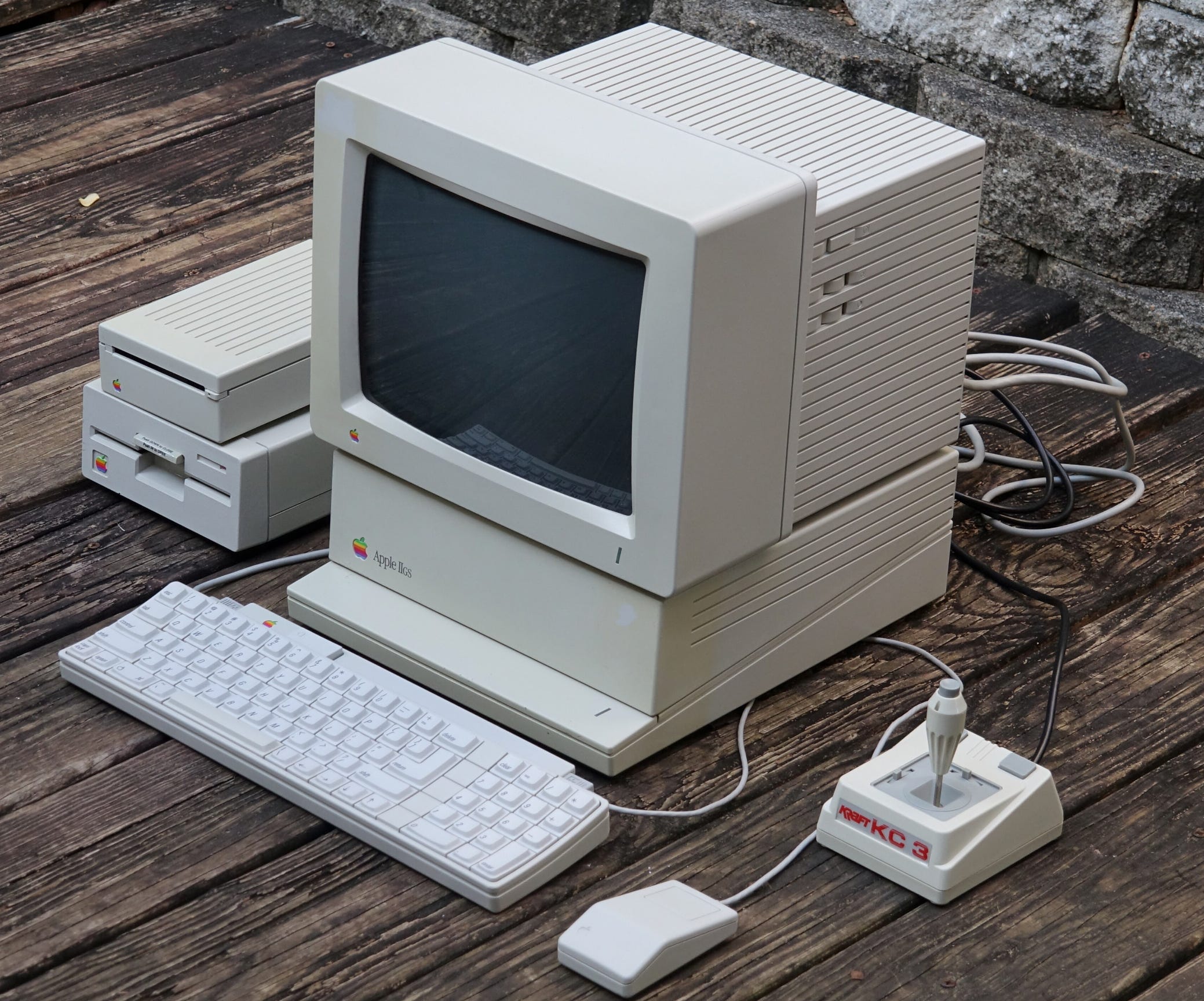
For my junior year, the high school added a new class: Pascal Programming. I was excited for this one because we would be using the brand-new Apple IIGS systems that the school had just acquired. Considering the IIGS had only just come out in 1986, this was my first glimpse at a somewhat new computer. At this point I had not used an Atari ST or Macintosh.
The class was taught by a first-year math teacher, who I also had for Algebra III. She didn’t really seem to know anything about programming or Pascal and was apparently just assigned the class because no one else wanted it, or because she was new and had no choice.
One of my classmates was Dominic Giampaolo, who was a year ahead of me. Dom and I were the two “experts” in the class and would help the teacher and other students. I remember Dom and I would have discussions about which computer was better, the IIGS, Amiga or Atari ST.
Dom eventually went to work for Apple and was one of the primary developers that worked on the APFS file system that is now used by all iOS and Mac devices.
The Apple IIGS was a fun computer. To me, it was everything the original Apple II was not. It was fast, colorful, stylish and easy to use. It sort of felt like a color Mac to me, although I had not used an actual Mac at that point.
The system had a GUI and was mouse-driven. I don’t specifically remember what we used for Pascal on the IIGS, but I remember it was integrated with the graphical UI, so it was most likely TML Pascal.
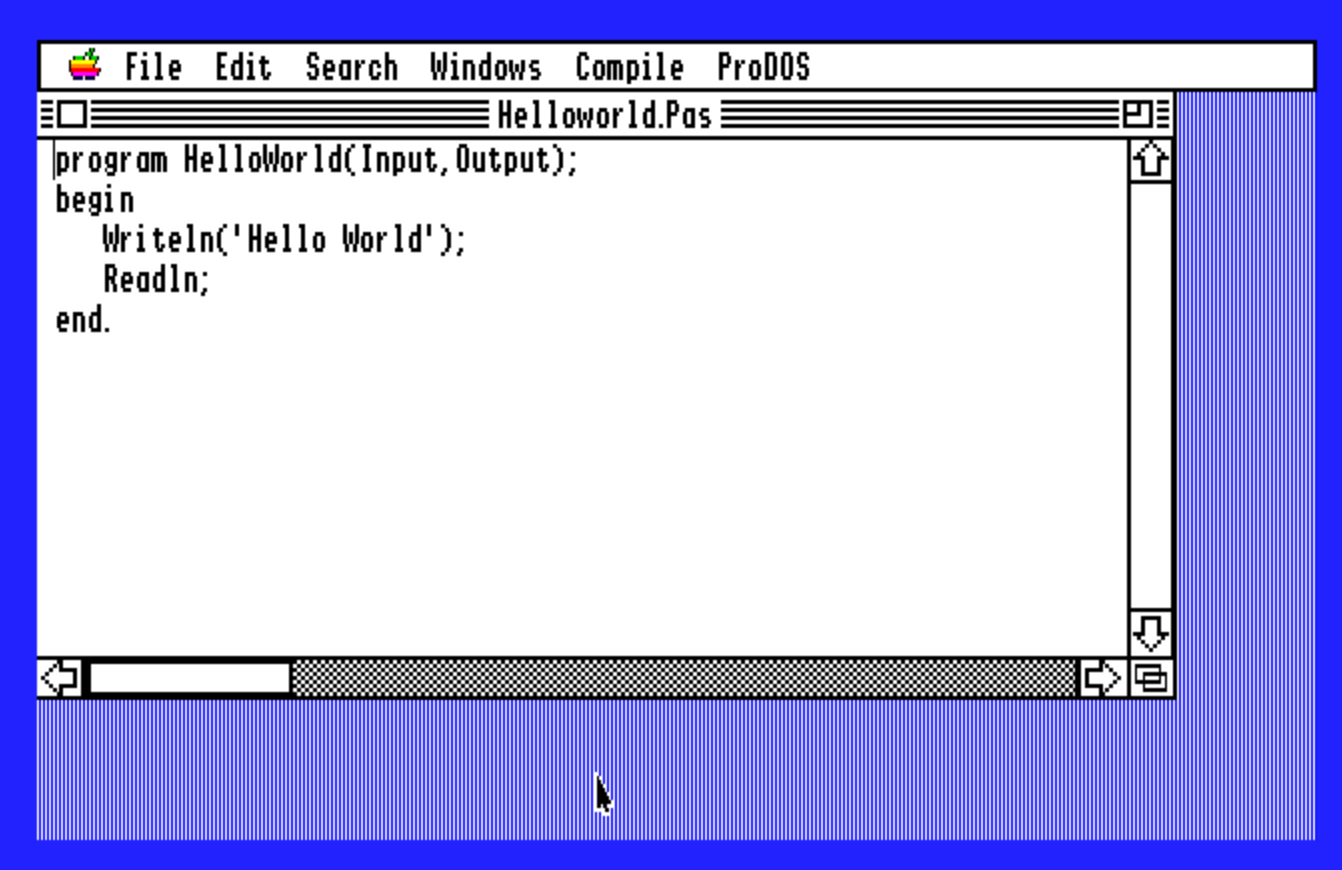
Compared to Kyan Pascal on my Atari 800XL, the Pascal on the IIGS was wonderful. It had an integrated editor, was fast and being mouse-driven, felt like the future.
However the IIGS was, like the Commodore 128, a bit of a Frankenstein computer.
The IIGS was compatible with most older Apple II software, but it could run in a faster mode at 2.8MHz, with a Mac-like GUI, using its 65C816 16-bit processor.
It also had a rather cool case design, but did require an external floppy and monitor. At about $1000 for the bare computer, it cost much more than an equivalent Atari 1040ST system from the time. But I suppose, for an Apple computer, it was probably somewhat reasonably priced. It certainly cost much less than a Macintosh!
Western Digital 65C816 CPU
The IIGS was made possible by the WD 65C816 hybrid CPU. Since the 68000, used by the Macintosh, Atari ST and Amiga, was not compatible with the 8-bit 6502, Apple decided to use this strange CPU from Western Digital.
This CPU was introduced in 1985 and probably seemed like it would be an obvious upgrade for the aging 8-bit computers that were prevalent at the time, but that didn’t really happen.
For its high-end 8-bit computer, Commodore decided to stuff two CPUs in the case and offer three modes: C64, C128 and CP/M. For its 130XE, Atari didn’t do much beyond increase the RAM to 128K. Apple is the only one that put in the work to actually try and build a true successor to their popular Apple II computer.
Computers with backwards compatibility always had a problem, though: How do you convince developers to make software that uses the newer features when they could instead stick with the old stuff and its larger market?
That hurt the 128, which had few 128-specific titles. I think the IIGS fared better, with the power of Apple behind it, but I suspect most developers that were interested in the new GUI stuff probably instead focused on the Macintosh.
After all, a hybrid has compromises. And in this case, the big compromise was performance. The 65C816 CPU ran at 2.8MHz, which was much lower than the 7.8MHz of the 68000 in the Macintosh (Atari ST was at 8MHz and Amiga about 7.1MHz). Even if the 65C816 might have been more efficient, people were starting to care about MHz by then and a slower number certainly didn’t help sales.
The IIGS was discontinued in 1992. By then the Classic Macintosh was similarly priced and the Color Classic was right around the corner and there just was not much need for the IIGS to stick around.
I see them pop up on Facebook Marketplace from time to time and I think about getting one, but I’ve managed to hold off. For now!
If you used an Apple IIGS I’d love to hear your thoughts in the comments!
The book is great and I’ll be covering it from an Atari angle soon.